This was my first big opinion piece that really got any traction, and I’m still pretty proud of it. There are a few straggling bits of my less mature writing style to be found here, but I think I really started to find my voice with this post. As for the actual subject matter, Samurai Shodown (2019) was a game I ended up flip-flopping on a lot as I slowly worked out what I liked and disliked about it compared to Samurai Shodown V Special. Ultimately, though, I’m glad it exists, because more than how it chooses to do or not do “footsies”, this game understands the most important thing about the Samurai Shodown series as a whole: every game is invariably fucking cursed.
So, uh, that new Samurai Shodown game will be upon us soon. As in “good grief it’s coming out in two weeks” soon.
There’s been a lot of hype surrounding the game, which is pleasantly surprising, considering that Samurai Shodown, while certainly being one of SNK’s more prolific franchises, doesn’t quite have the degree of influence their main fighting franchise, The King of Fighters, has within the FGC at large. SNK has been doing a bang-up job of marketing the game, using the #EmbraceDeath tag line to highlight the series’ signature gameplay, and — as is, really, par for the course when promoting an upcoming fighting game release these days — passing the game around at various conventions and fighting game tournaments to give people a chance to get their hands on the game.
Samurai Shodown has always been… weird. For a game with such a simple premise — you are person with sword, you fight other person with sword, someone dies eventually because it’s a sword fight — it plays in a remarkably non-standard fashion that has always managed to throw newcomers for a loop, including those who are familiar with other games in the genre. Even when a Samurai Shodown game is held together with more than just six months of dev time and a whole lot of duct tape and dreams (as was the most popular entry in the series, Samurai Shodown V Special), these games have never really played by the same rules as their contemporaries. Of course, behind all the strange bugs and mechanical mismanagement lies the core of the series that all of its fans have come to love — if you make one wrong move, you just might explode.
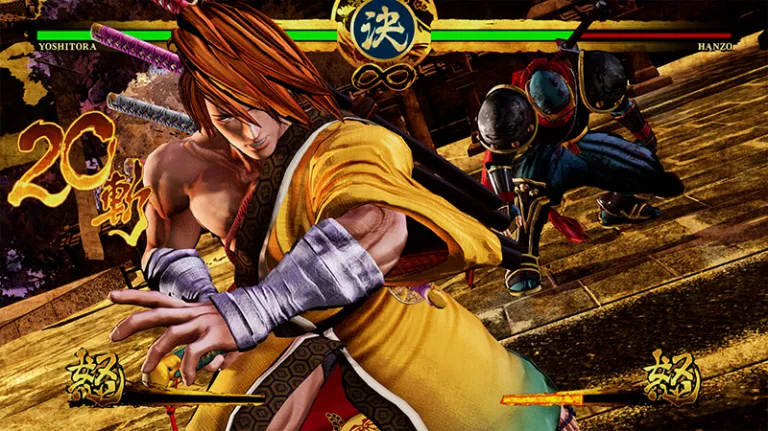
Yoshitora wants you to reflect on how you got yourself into this situation.
With there being so many ways to lose upwards of half your life bar in one fell swoop, Samurai Shodown has always been a game that can very easily switch between rapid movement-heavy offense and the most intense staredowns in fighting game history. With the game being so focused on singular pokes and punishes over long combos (or sometimes, combos at all), the series has gained a reputation for being about “footsies”, which establishes an expectation for people that the game will play in a certain way.
I’m talking about this expectation because there has been a contingent of people both in and out of my regular FGC discussion circles who have tried the game (or in some cases, only just looked at gameplay) and decried its slow walk speeds, saying that with such slow walk speeds you “can’t play footsies”.
I think these people have been set up to fail by Samurai Shodown’s reputation as a “footsies” game. Let me explain why.
“Footsies” is kind of a really loaded term when it comes to fighting game discussion, because it’s often heralded as what all good fighting games are about — an impressive feat considering that describing a fighting game as a “footsies” game means, broadly speaking, jack fuckin’ shit.
Well, okay, that’s not entirely true, but it doesn’t really say anything about the game in question. After all, footsies as a concept is very fundamental to the genre as a whole, and yet it’s also extremely nebulous, representing a vast array of interconnected skills relating to the neutral phase of fighting game play. Footsies is a very dense and layered topic of discussion, which is why people like Maj can write an entire book’s worth of blog posts on the topic, and why I think it’s extremely unhelpful to describe any fighting game as being a “footsies” game, since the breadth of skills that footsies covers can be applied in any number of ways depending on the game you’re playing.
Now, all of that being said, I’ll stop being a linguistic prescriptivist for one second and make clear what happens when you say a game is a “footsies” game — you invite comparisons to Street Fighter.
Street Fighter is the quintessential “footsies” fighting game. Now, I would argue that is the case because Street Fighter has, historically, been very barebones in terms of mechanical design — there’s very rarely any expansion on the most basic of movement mechanics, defensive options tend to be very limited, and characters are not designed to lock people down forever and make them eat repeated unreactable 50/50 mixups until they die. Essentially, it’s not Guilty Gear. So what does that mean? If you ask me, it means that Street Fighter is the “footsies game” because the design very rarely allows for situations where much else can happen. You play footsies in Street Fighter because that’s all Street Fighter really allows you to do. As such, Street Fighter wants players to utilise its limited movement options to play a mind game centered on controlling space — if you can move in and out of people’s effective ranges, you can bait them into overextending and get the whiff punish. That’s the basics. Street Fighter 101. And because of how prolific Street Fighter is, that’s essentially footsies 101. So what makes Samurai Shodown different? While space control is certainly important in Samurai Shodown — it is, after all, a fighting game — the slow walk speeds means that you can’t play that Street Fighter style of footsies that you normally associate with the word “footsies”. What I want to do is, instead of asking “why aren’t walk speeds faster?”, try asking “what does Samurai Shodown do to make this dynamic work?” And the answer is all in the risk-reward ratio. I’m gonna dig into some Samurai Shodown-specific mechanics here, so bare with me.
The main ways in which Buttons in Samurai Shodown are different from those in Street Fighter are thus:
- They deal significantly more damage
- Everything is horrifically negative on block
- The special cancel rules are completely different
Obviously the absurdly high damage potential is a very large factor, but it’s those second two points that are really of particular interest here. While your bog standard poke in, say, Street Fighter V, will generally be around -2 to -5 on block, buttons in Samurai Shodown range from “punishable” to “really punishable” on block. There is actual frame data, of course, but all of it tells you the same thing — your buttons are punishable. But that’s not where it ends, because now we get to talk about the game’s cancel rules. For one, if a normal in Samurai Shodown has a special cancel window, then that normal can be cancelled on whiff as well as on hit, which significantly muddies the waters when it comes to scouting out whiff punishes. And then there’s what happens when an attack gets blocked. You see, pretty much every normal that is performed with your weapon in Samurai Shodown will cause your character to enter a recoil animation on block — this is why all of your buttons are punishable on block. But what’s key here is that this recoil animation is also special cancelable. So, much like whiff punishes, block punishes in Samurai Shodown are not as cut and dry as they would be in Street Fighter, since attempting to punish a blocked normal could get you blown up with a yolo DP. Or, if you’re actually good at the game, a deflect, which gives you a free punish if it catches a slash.
So what does this mean for Samurai Shodown as a whole? Well, I think that the game’s particular flavour of risk-reward ratios means that, while it is a very neutral-heavy game with a good amount of poking, it is not a “footsie game” in the way we would normally imagine a game like that. The occupation of space plays a fundamentally different role here. You see, with buttons being so huge and so rewarding and punish situations being so ambiguous, combined with your lack of more precise movement options and greater number of proactive defensive options (such as deflect and spot dodge), the game encourages you to deal with your opponent’s offense head-on.
In other words, I’d like to posit that Samurai Shodown is a game about exploiting your opponent’s offensive rhythm by challenging it directly. You’re not moving around your opponent’s buttons, and punishment is not a simple affair in any scenario. So the only thing left to do is gain an understanding of when the opponent likes to throw out buttons, and then completely stop them in their tracks. Dodge it, deflect it, hell, throw out your own button, counter hit them with your heavy slash in the neutral and make them wish they had never been born. That’s why the neutral game can seem to shift so heavily in Samurai Shodown, switching from erratic movement to long bouts of nothing. No one wants to communicate their tempo, because the minute they do, it’s all over.
I wrote this because I want people to play Samurai Shodown — I want people to like it. And with the series being so weird, having the reputation for “footsies” that it has means that many players haven’t been able to approach the game on its own terms, and that’s a shame. So hopefully, this has given you some insight into what Samurai Shodown is all about, and allow you to better appreciate the game. After all, if you embrace the game for what it is, you will more readily be able to #EmbraceDeath.