SoulCalibur VI Pre-Release Impressions
There is not a day that goes by where I do not lament just how fucking dirty SoulCalibur VI got done. I’m much more of a classic SoulCalibur guy these days, but SCVI is easily the best that the modern incarnations of the series have to offer. Unfortunately, Bandai Namco is, to use my friend Pichy’s words, “a media dragon sitting on a hoard of immense cultural riches with absolutely no idea how to manage the wealth at all,” so it lies dormant and Motohiro Okubo, the game’s producer and greatest soldier, is now living his best life working for Cygames, making another weapon-based fighting game featuring a guy named Siegfried and 2B from NieR Automata, except I fucking hate Granblue Fantasy Versus: Rising. Happy for him, though.
That said, I really do wish Guard Impact actually worked the way I thought it did. Reversal Edge also ended up being way more annoying than I thought it would be, but they nerfed it into utter uselessness in season 2 so it worked out in the end. I miss this game, man.
Oh my god.
Just… just play the fucking game.
So, uh, I’m kind of a big fan of SoulCalibur. I played the absolute hell out of Soul Edge (known in the land down under as Soul Blade) and SoulCalibur II when I was a young lad, and after being introduced to the competitive side of the latter game by Aris (through this great video on his YouTube channel) shortly after the release of SoulCalibur II HD Online, it’s pretty safe to say that I’ve gained a very deep appreciation for the series. After being thoroughly disappointed by SoulCalibur V, the announcement of a new entry in the series at The Game Awards 2017 had me feeling… cautiously optimistic. I wanted so bad to believe that a new SoulCalibur would fix all of my issues with V, but couldn’t be completely sure that it would.
So I waited. Read promotional material and leaked gameplay details, watched trailers and match footage where I could, and while it was hard to gauge the game initially, I knew one thing — it kept looking better and better the more I saw of it.
And just this past weekend, Bandai Namco ran a network test for the game, much like they did with Dragon Ball FighterZ. My experience with the DBFZ network test was not exactly a positive one, but I was too excited at the prospect of finally getting to play SoulCalibur VI that I just didn’t care.
A quick overview. The entire download clocked in at just under 3GB (not bad at all!), giving players access to the options menu and ranked battles. There was a huge number of characters to choose from — almost the entire roster, in fact, only excluding Astaroth, Cervantes, Raphael and Seong Mi-na, as well as newcomer Azwel. However, that left players with a number of fan favourites to sink their teeth into, including franchise faces Mitsurugi and Sophitia, the poster boy Siegfried and his dark side Nightmare, the sorely-missed Talim and even newcomers Grøh (pronounced “gruh”) and the highly anticipated guest character, Geralt of Rivia from The Witcher. Oh yeah, and Voldo was there, too. As he should be.
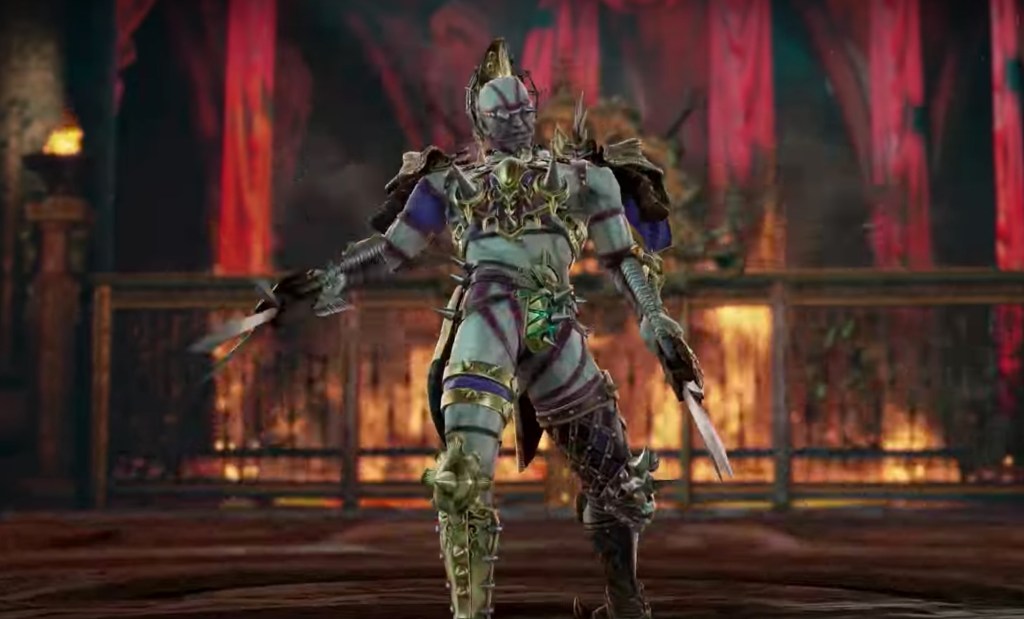
That codpiece has probably poked someone’s eye out before
Curiously enough, the controversial day one DLC character, Tira, was also playable for the network test. This may read as a little cynical, and given the way DLC is treated by both developers and fighting game fans, the optics aren’t really kind to her presence in what is ostensibly a beta version of the game, but producer Motohiro Okubo has expressed regret at how Tira was handled as DLC for the game, and this may be Project Soul giving players a chance to try out the character free of charge before the game proper is released. Then again, I’m biased and could never imagine Project Soul betraying me, so take it how you will.
First and foremost, the game was a network test. Bandai Namco pushed out a beta version of the game to both get people interested in the full game, as well as testing the game’s networking capabilities. At the start, it was very much a Bandai Namco Network Test. Much like DBFZ, there was a lot of waiting between matches and even the occasional network error impeding my progress, but in what can only be considered an act of divine providence, I was able to get a number of matches in over the course of the test. In fact, my experience actually improved as the beta went on, if you can believe it. I steadily got more and more matches, and while my individual match experiences began a fair bit on the choppy side, with plenty of stuttering and input lag, I got enough real matches to make up for it, as well as give me a good sense of how the game plays.
It plays good. So good.
Movement has taken a turn for the significantly better compared to SoulCalibur V. Gone is the Quick Step mechanic, with basic sidesteps and 8-Way Run now carrying evasive properties naturally. Characters also move at a gorgeous fast pace, leading to a movement-heavy neutral game with a fast and very natural flow to it. Combined with the series’ trademark ease of control, the game feels like a dream to play. SoulCalibur has always been a representation of everything I wanted from Tekken — a fast-paced movement-centric footsie game — and this is a huge part of why.
The new Guard Impact mechanics are really smartly designed as well, blending the omni-guard nature of SoulCalibur V’s metered GIs with elements from every previous SoulCalibur game. Guard Impact, performed with 6G, will parry every strike at every hit level, as well as throws, but will automatically lose to moves classified as Break Attacks or Unblockable. It no longer costs meter, but instead drains a portion of your character’s guard bar, with successful GIs refunding the guard bar you spent to perform it. The classic post-GI mindgames of older SoulCalibur is back, with the added twist of new depth in the timing element, thanks to variable frame advantage being awarded to players depending on how close their GI was to impact — the closer the better. This particular system is really smart, since the omni-guard GI effectively works as a way to deny opponents a mixup, but on top of being able to bait out GI attempts with the various feints and slow attacks the game gives you, as well as ways to beat GIs clean thanks to Break Attacks and Unblockables, the variable advantage means that a successful, but slightly mistimed panic GI is more likely to just reset to neutral rather than create an advantage that anyone can press.
Reversal Edge is also a ton of fun. B+G basically performs a focus attack (it can be charged), and your character will guard all attacks thrown their way (although much like GI, it still loses to Break Attacks and Unblockables) before unleashing a vertical strike. If it hits, both players are put into an Injustice-style Clash scenario, where each inputs one of a number of options — the three attacks, which work in an RPS-style triangle, as well as guarding and three movement options, which all beat and lose to different things. It’s not a particularly intrusive game mechanic, and while there’s not a lot of consistency to it as a defensive option, the Clash scenario operates as something of a microcosm of the semi-RPS mechanics already present in the game, and having this be distilled into the Reversal Edge mechanic really reinforces it as a more beginner-friendly addition to the game, which I have no qualms with. The visual effects are fun, and the Reversal Edge attack itself has a lot of utility to it, thanks to its damage and its heavy meter gain.
The new Lethal Hit mechanic functions as something of an analogue to Crush Counters in Street Fighter V, but with the added complexity of having these effects have specific activation conditions that extend beyond just a counter hit. Some moves Lethal Hit as whiff punishes, others on side hit, and all Break Attacks will Lethal Hit versus Guard Impact and Reversal Edge. Lethal Hits temporarily slow down time, cause the camera to pan into a more cinematic angle, and the opponent’s armour will break according to where you hit them — with no effect on their defense, of course. Lethal Hits often allow for extended combo opportunities, and really add an element of visual flair to the game without sacrificing any depth. In fact, the broad and varied activation conditions for Lethal Hits really add to the gameplay, helping to reinforce certain aspects of each character’s playstyle.
There’s a lot more I could talk about, but we’d be here all day if I did. The new throw mechanics work nicely, each of the characters feel familiar and fresh all at once, with plenty of new toys that fit neatly into their existing archetypes, the game looks absolutely gorgeous and god, everything about this game is a dream come true.
Returning to the stage of history has never felt this good.