WWE Undefeated: First Impressions
The tragedy of WWE Undefeated is one of the greatest indictments of the modern mobile game landscape, because this game was unquestionably the best attempt at a fighting game for mobile devices ever created. Unfortunately, because it rewarded players being good at the game more than it rewarded people whaling for the newest playable characters, it died while Power Rangers Legacy Wars still chugs along. There is no such thing as cosmic justice.
I don’t normally do the whole mobile game thing. They’re usually massive time sinks and even larger money sinks, almost always without any actual engaging gameplay to back them up. This was set to change when I found out about a recently released mobile game called WWE Undefeated, a tie-in with the WWE wrestling promotion that – hey wait a minute
Alright, so nWay has basically made Power Rangers: Legacy Wars 2. For those of you that have seen what I’ve had to say about nWay’s last attempt at a fighting game for mobile devices, that might be cause for concern. But perhaps more shocking than the fact that nWay got the chance to work with one of the world’s biggest multimedia licenses (even bigger than Power Rangers!) is the fact that they… actually made a good game this time?!
WWE Undefeated has been in the works at nWay for quite some time now, and with the game finally releasing on iOS and Android devices, I’ve been playing a fair amount of it. What’s struck me the most is that the developers at nWay really seem to have taken all the lessons from their time with Legacy Wars (and perhaps even their full-blown console fighting game, Power Rangers: Battle for the Grid) to heart, and have made a game that really capitalises on its basic mechanical premise while making lots of smart, positive changes compared to its predecessor that leave WWE Undefeated feeling much more rewarding to play, by comparison.
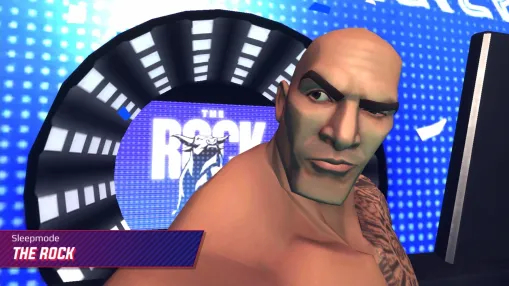
The Rock is the character you start the game with, which I think is probably the game’s most genius marketing move.
I won’t spend too much time talking about the progression systems and collect-a-thon metagaming stuff, because it’s more or less all the same as in Legacy Wars. Loot boxes on timed unlocks are all still here, you collect character cards (10 to unlock a character, duplicates are used to level them up), you can join alliances (called Factions in this game) to ask for and donate cards, there’s ranked PVP leagues that provide different things to unlock — it’s all pretty familiar territory. It’s worth mentioning, though, that a couple of great quality-of-life changes have been added to the loot box system. The game now allows you to build up to guaranteed box rarity upgrades through each win, making playing the game even with full box slots much more rewarding (outside of the satisfaction of beating your opponent fair and square), and you can now queue up a second loot box to start unlocking immediately after your first one finishes.
As far as the collection stuff goes, there’s no secondary upgrade materials to collect, such as the Orbs of Eltar and Essences found in Legacy Wars. Aside from characters, all you get is ability cards. And, just so we’re all on the same page, Undefeated is a one-on-one game, as opposed to the three-on-three format Legacy Wars used. So instead of building a team of three characters, you actually just customise your character’s move pool!
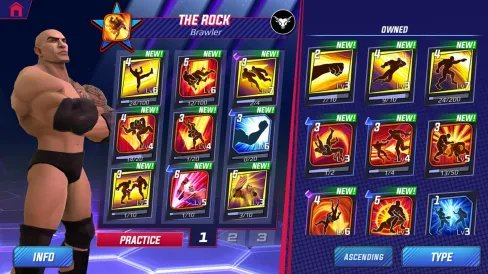
The “game before the game”, as it were, will entertain fighting game players and deck-building enthusiasts alike.
That’s right, playing a character also means building an ability deck for them! Building a deck for a character is actually quite interesting, since every character is differentiated by their passive skill and their unique moves, of which they have three — two Signature Moves, and a Finisher (which we’ll talk about later). For example, The Rock here has a passive that grants him bonus damage and EP regeneration as long as he has his Finisher available, and his two Signatures are The People’s Punches (a fairly fast Strike which can lead to high damage under the right circumstances), and The People’s Elbow, a move designed specifically to hit knocked down opponents. Because of this, I’ve tailored my deck for The Rock to contain as many ways as possible to consistently score a knockdown, just so I can convert that into a People’s Elbow whenever I have the opportunity. There are quite a few ways you can tailor your deck to your chosen character and preferred playstyle, which both does wonders for general character viability (Legacy Wars had huge problems with character balance even after its initial release) as well as player creativity. It’s a really smart system!
But okay, there’s an actual video game underneath all the collecting and customising. Y’know, the kind I’m supposed to play with other people? That super cool deck I just built for The Rock has to mean something. So how does the game work?
The core gameplay elements are the same as in Legacy Wars. Moves are still drawn into an Ability Deck at random (though this time moves just show up wherever instead of in predetermined slots), moves still require a resource (called Energy) to use, said moves operate on a rock-paper-scissors triangle system (the three categories here being Strike, Grapple and Defensive), movement is still simple dashes achieved through swipes, you know the drill. The differences are quite stark, though, and really demonstrate just how far nWay have come in their ability to design fighting games.
Two of the more subtle changes have to do with the functions of specific abilities. One of the biggest issues with Legacy Wars upon its release was the plethora of multi-hit Strike attacks that left the opponent standing the whole way, all of which could be interrupted by the opponent at any time if they had a Defensive ability on hand, guaranteeing them a punish or at least a clean break to return to neutral. This was somewhat remedied in later versions of the game, where the first hit of these attacks became near-universally dash cancelable in order to facilitate a mind game that involved baiting potential block attempts. Undefeated has made the (in my mind) very smart decision to forego this mind game altogether, simply allowing all Strike abilities to fully chain their hits together in all circumstances. Coinciding with this is a change to how Defensive abilities work — there is no longer a universal 0EP Block ability like in Legacy Wars, with players now needing to consciously include Defensive abilities in their deck if they want to stand a chance at actually countering Strikes. On top of that, the one Defensive ability that all players start with, Parry, costs 1EP — a small cost, to be sure, but a cost nonetheless. In turn, not only does every Defensive ability now deal damage, a majority of them now lead into guaranteed combo follow-ups if you have the EP to spare (and the ones that don’t usually do dino damage anyway). With Strikes being so much more valuable and Defensive abilities being much more of a commitment, this leads to players spending a lot more time moving around and fishing for whiff punishes. Which, of course, leads to the next few changes I want to talk about.
Stage positioning plays a much larger role in Undefeated compared to Legacy Wars due to a couple of key changes. The first is that stages in Undefeated are much larger than in Legacy Wars, which gives players way more room to vie for positioning, control space and actually play some honest-to-god footsies. Players will get a lot of mileage out of throwing out attacks within a certain range of their opponent if they expect a dash in, and in higher leagues, where the more experienced players are fully aware of how strong this strategy is, you get some incredibly intense staredowns rivaling even those of Samurai Shodown as a result. It’s incredibly compelling.
Next, a large number of actions in the game can cause you to swap which side of the screen your character is on. This is not something that could ever happen in Legacy Wars, so it’s basically brand new here. This is extremely important as well, because a game with movement as limited as this has precious few ways of escaping the corner, where there is far more potential for big combos and devastating mixups. Doubly so in Undefeated because of one last big change — a good number of moves (mostly Strikes, but even some Grapples) now cause an extended hitstun state (mostly Wall Splat, but there’s at least one move that causes Wall Bounce) when they slam an opponent into the corner.
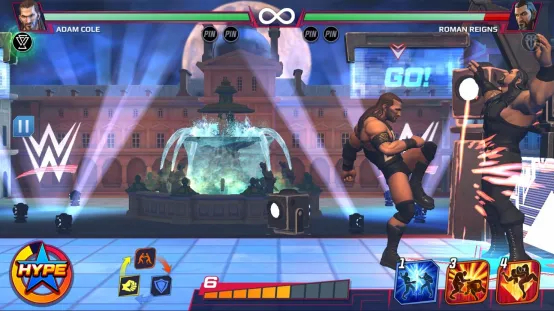
One of the benefits of Wall Splat is the extra long hitstun animation that ends in a knockdown. On top of starting combos, this also gives you tons of time to recharge EP!
This means that many moves which would normally only allow a small follow up midscreen can lead to your character’s most damaging moves in the corner, which makes stage positioning all that more important. This is an incredibly fun dynamic that Undefeated has executed near-flawlessly.
A new mechanical addition adds an interesting scruple to the game’s basic triangle system as well. When two players use a Grapple ability at roughly the same time, both players will enter into a Grapple Clash, where a short clinch animation plays before the game determines a winner. The winner of the Grapple Clash is determined by the most expensive Grapple used in the Clash — the higher your Grapple’s EP cost, the better chance you have at winning. If the cost of both Grapples used to initiate the clash was the same, then both characters jump back, resetting to neutral.
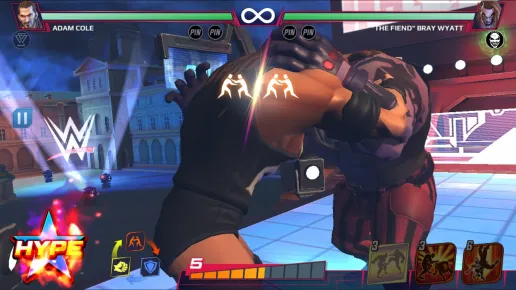
After this, the in-game announcer will tell me that I’m smart because I did a DDT.
This is a much smarter mechanic than initial impressions might give off, entirely because of the effects it has on decision-making surrounding your character’s Grapples. Primarily, it ensures that players have some means of potentially defending themselves against an opponent’s Grapple if they don’t happen to have any Strikes on hand, but it also incentivises players to potentially save their more expensive Grapple abilities for sticky defensive situations in order to ensure a win for them in a Grapple Clash. It’s a mechanic that adds a ton of wrestling flavour to a match without sacrificing any positive function.
Finally, the most important mechanical additions to the game are Finishers and the Pin system. Finishers are effectively character-specific supers that can be activated once your character’s Hype meter has been filled (by dealing and taking damage). Finishers add another fun scruple to the ability triangle entirely due to the fact that they completely ignore it — they are invincible to everything except other Finishers, and will also bypass Defensive abilities.
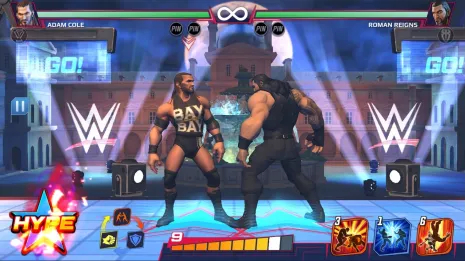
When your Hype meter is full, tap the button…
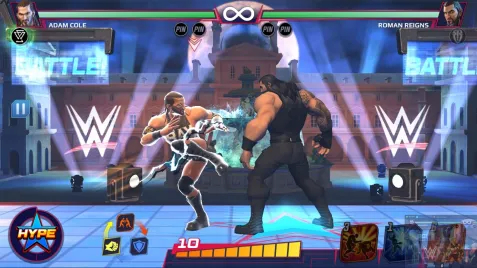
…and claim your invincible unblockable!
They don’t deal very much damage compared to some of the stronger normal abilities in the game, likely because of just how easy it is to actually hit people with them, but they lead into a very fun dynamic where both players will try to hang on to their Finisher until either the opponent uses theirs first, or it will guarantee a kill (since with the right cards it’s possible for many characters to combo after their Finishers). This is especially interesting for characters with passives related to the Hype meter. The Rock, as mentioned, has his damage and EP regen boosted while he has his Finisher available, but Adam Cole, on the other hand, has his damage and EP regen boosted while he doesn’t have his Finisher available. On top of character and deck-specific potential to score a combo after landing a Finisher, they represent very unique and interesting threats for people to deal with, especially since it’s often better to save your Finisher specifically to beat out an opponent’s attempt at one. For me personally, this has led to some pretty funny instances of a kind of self-imposed mixup where I’ve just let myself get hit by a totally raw Strike because I was expecting my opponent to just go for their Finisher immediately after dashing up.
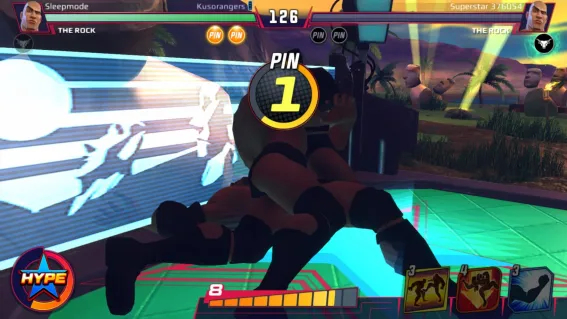
DOWN!
The Pin system is also a big one, as it’s another one of the ways that Undefeated simulates a real aspect of professional wrestling while also making a very positive change to the gameplay. In Legacy Wars, matches were best-of-one, meaning you got very few chances to actually try and figure your opponent out, especially with how incredibly high damage could get on some combos. Undefeated remedies this by adding a round system very similar to the one used by Vampire Savior — when you deplete the opponent’s life bar completely, you go into an animation where you hold them down in a pin, after which (if it’s the first pin) they will kick you off and you’ll return to neutral, but the life of the player who scored the pin doesn’t reset. This does a fantastic job of giving players more chances to play the game and really feel each other out without completely changing the fairly fast, continuous pace of matches that Legacy Wars established.
All in all, the game is genuinely fantastic. It’s hard to really point out much it’s doing wrong. Of course, the app itself isn’t particularly stable (one of the battle planners for the game has admitted this much to me), but it operates remarkably well for a 1.0 release for smartphones. The most egregious problems are sound glitches and the game occasionally hanging after finding a match, but otherwise it more or less runs without a hitch. I guess the only other criticisms I have is that the music is a little bland (seriously, we need to get Virtua Fighter 4 Evolution levels of butt-rock in here) and the lighting on the beach stage is kind of suspect. Otherwise, I’m honestly going to have a hard time not recommending this game. There’s a lot to love already, and I have every reason to believe that it’s only going to get better. It’s free to play, you can play it on your phone, and with the help of an Android emulator like Bluestacks or MEmu, you can play it on your PC! (Shout outs to the super cool designer who left the developer keybinds in the game so I don’t have to set up my own keybinds in the emulator. That’s some real QOL design right there.)
In other words, you’ve done it, nWay. Colour me very impressed.